Showing posts with label Islam. Show all posts

About


This site is dedicated to those members of the Prophetic Household (the Ahlel Bayt) who have been abandoned and forsaken by the Shia. This includes the Prophet’s wives–Aisha (R.A) and Hafsa (R.A)–as well as his daughters: Zaynab (R.A), Ruqayyah (R.A), and Umm Kulthoom (R.A). It is evident that the Shia propagandists have slandered the Prophet’s wives and have even denied the existence of three of his lovely daughters. It is for this reason that we amongst the Ahlus Sunnah wal Jama’ah (i.e. the mainstream Muslims) find it incumbent upon ourselves to defend the honor of the Ahlel Bayt, and to become the intellectual Vanguard of Sunni Islam.

The Ahlel Bayt were never Shia, but rather were always part of the mainstream Islam. How could the Ahlel Bayt be Shia when Allah said in the Quran:


 مُنِيبِينَ إِلَيْهِ وَاتَّقُوهُ وَأَقِيمُوا الصَّلَاةَ وَلَا تَكُونُوا مِنَ الْمُشْرِكِينَ ﴿٣١﴾ مِنَ الَّذِينَ فَرَّقُوا دِينَهُمْ وَكَانُوا شِيَعًا ۖ كُلُّ حِزْبٍ بِمَا لَدَيْهِمْ فَرِحُونَ ﴿٣٢ 


"and be not amongst those who join gods with Allah, those who split up their Religion, and become shias (sects) - each party rejoicing in that which is with itself". (Quran, 30:31-32) 
The transliteration of the Arabic reads:

“Muneebeena ilayhi waittaqoohu waaqeemoo alssalata wala takoonoo mina almushrikeena. Mina allatheena farraqoo deenahum wakanoo shia an kullu hizbin bima ladayhim farihoona”

In the Nahjul Balagha, one of the most revered books of the Shia, Ali (R.A) said in Sermon 126:

"With regard to me, two categories of people will be ruined, namely he who loves me too much and the love takes him away from rightfulness, and he who hates me too much and the hatred takes him away from rightfulness. The best man with regard to me is he who is on the middle course. So be with him and be with the great majority of Muslims because Allahâ hand of protection is on keeping unity. You should beware of division because the one isolated from the group is a prey to Satan just as the one isolated from the flock of sheep is a prey to the wolf. Beware! Whoever calls to this course [of sectarianism], kill him, even though he may be under this headband of mine." (Source: Al-Islam.org, http://www.al-islam.org/nahjul/126.htm)
It is truly sad that people have exploited the memory of the Ahlel Bayt in order to schism into various sects, against the Command of Allah. The Ahlel Bayt were Muwahiddoon (Unitarians of Islam) who would never split into sects. The Ahlel Bayt website was designed by the Muwahiddoon as an open invitation to the Shia of the world to reject sectarianism and accept the Islam of the mainstream orthodoxy, the same group to which the Ahlel Bayt belonged to.

Note: The site " http://www.ahlelbayt.com " no more avaialbe at the web, this has been recovered with great effort [see note below]

Ahlel Bayt Website Links:

--------------------------------------------------------------------------------
Copyright © 2005 Ahlel Bayt. All Rights Reserved.

admin @ ahlelbayt . com          webmaster @ ahlelbayt . com


The Articles published on this website may be reproduced provided they are not modified in any way and credit is given to the Ahlel Bayt website.
------------------------------------------------------------------------------------------------
Note: The site is no more traceable at the web, reproduced here for the benefit of Muslims and humanity, with due credit to the those who originally produced Ahlel Bayt website. I discovered an other similar site: http://www.chiite.fr/en/index.htm  
JAZAK ALLAH
-------------------------------------------------------------------------------------

www.ahlelbayt.com

This is an excellent Web site with complete details about Shias, but the website is down due to unknown reasons, you can down load the offline version of this complete website, save in your computer, tablet or mobile phone to read the articles in your own time. Please follow these steps:
1- Click here go to : http://www.box.net/shared/r0dmyfa0jy
2- Download the off line,  Ahlel Bayt website.rar  and save in hard drive of your computer.
3- This is .RAR file which is compressed to uncompress / open this file go to this link: http://download.cnet.com/Free-RAR-Extract-Frog/3000-2250_4-10804840.html
4. From here Download software 3.2 mb:  Free RAR Extract Frog 2.50
5- Install this Free RAR Extract Frog 2.50 
6- Open the ahlelbayt.com Offline Version  which you downloaded and saved in computer HD with Frog2.5.
7- The extracted file will be saved in the same folder, open the file and work off line. [Size of open site is 29 mb]. Its easy and simple
------------------------------------------------
INDEX
http://www.chiite.fr/en/
  1. Ahlul Bayt
  2. Imamah
  3. Shia Text
  4. Shirk
  5. History
  6. Sahabah
  7. Racism
  8. Mutah
  9. Taqyia
  10. Mehdi
  11. Tahreef
  12. Islam
  13. Rebutals
  14. Hadiths

Index - AhlelBayt.Com


Articles

Here, you will find a wide variety of articles organized according to topic. Clicking on the relevant hyperlink should take you to the full text. Because we arranged the hyperlinks in a certain manner so as to maintain an optimum flow and a cohesive train of thought, it is best to read the articles in the order that they appear below.
------------------------------------------------
INDEX

  1. Ahlul Bayt
  2. Imamah
  3. Shia Text
  4. Shirk
  5. History
  6. Sahabah
  7. Racism
  8. Mutah
  9. Taqyia
  10. Mehdi
  11. Tahreef
  12. Islam
  13. Rebutals
  14. Hadiths
  • Prophet’s Wives are Ahlel Bayt
  • Prophet’s Daughters are Ahlel Bayt
  • Word Games With Verse 33:33
  • Half Hadith-ing (Zaid ibn Arqam)
  • The Status of Ahlel Bayt
  • Foundation of Shi’ism is Nasibi
  • Slander Against Prophet’s Wives
  • Mothers of the Believers
  • Al-Ifk: Quran Defends Aisha (R.A)
  • First Lady of Islam
  • Verse 33:33 Does Not Make Anyone Infallible
  • The Wives of Prophet Nuh (pbuh) and Prophet Lut (pbuh)
  • Shia Du’a (Saname Quraish) Curses Two of Prophet’s Wives
  • Love for Ahlel Bayt and Sahabah
  • Aisha (R.A) Didn’t Do Ghusl in Front of Men
  • How the Shia Abandoned the Ahlel Bayt
  • Fatwa: Kufr to Slander Bibi Aisha
  • Al-Islam.org says: Do not name your daughter with the name “Aisha”
  • Who are the Ahlel Bayt?
  • Grand Ayatollah On Cursing the Prophet’s Wives/Companions and Taqiyyah
  • 154 Wise Sayings of Sayyiduna Ali
  • Sayyida Aisha is Part of Ahlel Bayt
  • The Prophet Defends His Wife Aisha
  • The Status of the 12 Imams
  • Grand Ayatollah al-Kho’i Says Wife is Part of a Man’s “Ahl”
  • Tahreef (Tampering) of Verse 33:33
  • Video: Shia Scholars Cursing and Insulting Prophet’s Wife
  • The Quran Challenge
  • The Quran Challenge, Part II
  • The Quran Challenge, Part III:
  • The Quran Challenge, Part IV
  • Shi’ism is Kufr: Imams Superior to Prophets
  • Infallibility = Shirk
  • Imamah and Shirk
  • Imam Knows the Hour of His Death
  • Imams Can See Al-Ghaib (the Unseen)
  • Al-Kafi or Al-Kufr?
  • Ayatollah Khomeini
  • Imamah: the Antithesis of Egalatarianism
  • Turbulent History of Imamah
  • Fraudulent Representatives of the Hidden Imam
  • How Does the Current Imam Lead the Shia?
  • Some Questions for the Shia
  • Let’s Say That I Wanted to Convert to Shi’ism…
  • The 12th Imam of the Shia is Dajjal?
  • Fatwa: Ayatollah Khomeini is not Muslim
  • Reply to Email: Were Ali, Hasan, and Hussain Lying?
  • Quran (13:7): Not a Proof for Imamah
  • Shia Believe in Holy Books After the Quran
  • Saying “Ya Ali Madad” is Shirk
  • Ali (R.A) or Jesus (pbuh)?
  • Ali’s Message (R.A) in Nahjul Balagha
  • Turbah: Sajdah to the Imams
  • Grave Worship
  • Who Invented Shirk?
  • Fatwa On Saying “Ya Ali Madad”
  • Shrines: the Need to Raze Them and Level the Graves
  • Saqifah: A Sunni View
  • Battle of the Camel
  • Origins of the Shia Sect
  • Battle of Siffin
  • The Shia Killed Ali (R.A), Hussain (R.A), and Hussain’s Grandson (R.A)
  • Ali (R.A), Hasan (R.A), and Hussain (R.A) Hated the Shia
  • Rebuttal of Answering-Ansar’s Article “Who Killed Imam Hussain? (AS)”
  • Fatwa on Hussain’s Fighting Against Yazid
  • A Shia Killed Sayyiduna Hussain
  • Jewish Encyclopedia: Abdullah ibn Saba, Founder of Shi’ism
  • A Comprehensive Rebuttal of Answering-Ansar’s Article Entitled “Saqifa; the debacle of Islamic Government”
  • Hadith About Muawiyyah: “May Allah Not Fill His Belly” [A Sunni Perspective]
  • Fadak, Part I: Shia Hadith Confirms Abu Bakr’s Justice 
  • Fadak, Part II: Why Didn’t Ali (R.A) Return Fadak?
  • Fadak, Part III: Ahlus Sunnah is Not Abandoning the Quran
  • Fadak, Part IV: Shia Women Do Not Inherit Land Anyways
  • Fadak, Part V: Fatima’s Anger (R.A)
  • Fadak, Part VI: Fadak Was Not a Gift
  • Fadak, Part VII: Charity is Good
  • Fadak, Part VIII: The Quran Does Not Say Prophets Give Inheritance
  • Fadak, Part IX: Umar (R.A) Upheld Abu Bakr’s Decision (R.A)
  • Fadak, Part X: The Shia Who Deny Our Interpretation of the Al-Kafi Hadith
  • Fadak, Part XI: Respect for Fatima (R.A)
  • Fadak: Part XII, Conclusion
  • Neither Abu Bakr Nor Umar Was a “Liar, Sinful, Treacherous, and Dishonest”
  • Four Caliphs and Prophet Related by Marriage
  • Ali  Gave His Daughter to Umar 
  • A Comprehensive Rebuttal of Answering-Ansar’s Article on Umm Kulthoom’s Nikah
  • Shia Websites Confirm Umm Kulthoom’s Marriage to Umar
  • Ali ibn Abi Talib Named His Sons after the Three Caliphs [includes a rebuttal of Answering-Ansar]
  • Marriages of the Four Caliphs and the Prophet (R.A)
  • Abu Bakr (R.A), the Second of the Two
  • The Four Rightly Guided Caliphs
  • Al-Islam.org Admits that Umar Married Ali’s Daughter
  • Grand Ayatollah On Cursing the Prophet’s Wives/Companions and Taqiyyah
  • Hadith About the (Non)Incident of the Pen and Paper [A Sunni Perspective]
  • Abu Bakr and Ali Related Through Marriage
  • The Prophet’s Praise of Abu Bakr
Racism in Shi’ism
  • Mutah
  • Al-Shia.com on “Rewards for Doing Mutah”
  • A Plea from a Muslim Sister
  • More Shia Hadith on Mutah
  • The Mutah Pimps
  • Mutah and Hypocrisy
  • Ayatollah and Mutah
  • The Fiqh of Mutah
  • Legalized Whore-Houses in Iran
  • Supreme Leader Khamenei on Mutah
  • In Mutah, Man Does Not Provide Support to Woman Nor Child
  • Mutah is Haram
  • Making a Living from Mutah Prostitution
  • Grand Ayatollah Sistani’s Fatwa: Virgin Girls Can Do Mutah
  • Shia Hadith: Woman Who Does Mutah Twice Will Become Pure
  • Fatwas: Permission of Wali Not Required for Mutah; Shia Guy Can Take Sunni Girl in Mutah
  • Misyar Marriage is Not Like Mutah
  • Grand Ayatollah Sistani on the Only Difference between Mutah and a “One Night Stand”
  • Shia Website Al-Islam.org Says A Woman Who Enters Into Mutah is “Rented”
  • USA Today: ‘Pleasure Marriages’ (Mutah) Regain Popularity in Iraq
  • Marriage With the Intention to Divorce
  • Taqiyyah
  • Realplayer Audio: Taqiyyah
  • Grand Ayatollah On Cursing the Prophet’s Wives/Companions and Taqiyyah
  • Shaykh al-Mufid, Tahreef, Taqiyyah, and Half-Quoting
  • Al-Raj’ah [The Return]: Imams Reincarnated
  • Shaykh al-Mufid, Tahreef, Taqiyyah, and Half-Quoting
  • Shaykh al-Mufid and Tahreef, Strike Two
  • Tahreef (Tampering) of Verse 33:33
  • Tahreef (Tampering) of Verse 11:73
  • Answering-Ansar’s Guru Says Current Quran is “Incomplete” and “Not Enough”
  • The Quran Condemns Sects
  • Are the Shia Considered Muslims? A Balanced Answer
  • Kindness Towards the Shia
  • Mufti Taqi Usmani did NOT sign the “Amman Message”
  • Is AhlelBayt.com a “Salafi” Site?
  • How Reliable is “The History of at-Tabari”?
  • Why Prophet Muhammad Did Not Have a Wasi
  • Imam Bukhari’s Fatwa on Befriending Shias
  • Hadith of Ghadir Khumm [A Sunni Perspective]
  • A Comprehensive Rebuttal of Answering-Ansar’s Article on Umm Kulthoom’s Nikah
  • Rebuttal of Answering-Ansar’s Article “Who Killed Imam Hussain? (AS)”
  • Ali ibn Abi Talib Named His Sons after the Three Caliphs [includes a rebuttal of Answering-Ansar]
  • Abu Bakr (R.A), the Second of the Two
  • Hadith About Drinking Urine in Sahih Al-Bukhari
  • Hadith About the Quran and Sunnah
  • Hadith al-Thaqalayn: The Two Weighty Things [A Sunni Perspective]
  • A Comprehensive Rebuttal of Answering-Ansar’s Article Entitled “Saqifa; the debacle of Islamic Government”
  • Hadith of the Twelve Caliphs [A Sunni Perspective]
  • Reply to Email: Were Ali, Hasan, and Hussain Lying?
  • Shaykh al-Islam Ibn Taymiyyah’s Love for Ahlel Bayt
  • Response to Shia Accusation that Our Website Lied; Women Do NOT Inherit Land in Shia Hadith
  • Hadith About the (Non)Incident of the Pen and Paper [A Sunni Perspective]
  • Accusing the Prophet’s Wife of Murder: “Kill this old fool (Na’thal)”
  • Response to Rayat’s Article Entitled “Imam Ali’s Sons”
  • Hadith About the Prophet Contemplating Suicide
  • Reply to an Email
  • Hadith of Ghadir Khumm [A Sunni Perspective]
  • Hadith About Muawiyyah: “May Allah Not Fill His Belly” [A Sunni Perspective]
  • Hadith About Drinking Urine in Sahih Al-Bukhari
  • Hadith About the Quran and Sunnah
  • Hadith al-Thaqalayn: The Two Weighty Things [A Sunni Perspective]
  • Hadith as-Safinah (of Ahlel Bayt being like Noah’s Ark) is a Forgery
  • Hadith of the Twelve Caliphs [A Sunni Perspective]
  • Hadith About Aisha’s House and Satan’s Horns [A Sunni Perspective]
  • Hadith About the (Non)Incident of the Pen and Paper [A Sunni Perspective]
  • Hadith al-Manzilah [A Sunni Perspective]
  • Hadith About as-Siddeeq al-Akbar [A Sunni Perspective]
  • Hadith About the City of Knowledge and Ali is its Gate [A Sunni Perspective]
  • Hadith About the Prophet Contemplating Suicide
  • Hadith About No Sword Except Dhul-Fiqar [A Sunni Perspective]
  • Hadith About Dying With Hatred Towards Ali [A Sunni Perspective]
  • Hadith About Shias Being Best of Creation [A Sunni Perspective]
Ahlel Bayt Website Links:

If there is any problem, may try these links:
http://www.chiite.fr/en/
  1. Ahlul Bayt
  2. Imamah
  3. Shia Text
  4. Shirk
  5. History
  6. Sahabah
  7. Racism
  8. Mutah
  9. Taqyia
  10. Mehdi
  11. Tahreef
  12. Islam
  13. Rebutals
  14. Hadiths

--------------------------------------------------------------------------------
Copyright © 2005 Ahlel Bayt. All Rights Reserved.
admin @ ahlelbayt . com          webmaster @ ahlelbayt . com
The Articles published on this website may be reproduced provided they are not modified in any way and credit is given to the Ahlel Bayt website.
------------------------------------------------------------------------------------------------
The site is no more traceable at the web however some one has reproduced it at: http://www.chiite.fr/en/
------------------------------------------------

Matum


The Shia practises of Matam are no doubt an embarassment to many Shia living in the West; thus, many of them claim that Matam is done only by misguided Shia who are “ignorant” and “extremist” fringe elements. This is a blatant lie (or sheer ignorance): Matam is part and parcel of Shi’ism. We shall herein see how the Shia Maraje’ (top scholars) advocate Matam, even Tatbir (shedding of blood with swords). Then, we shall see what the Shia practise of Matam really is. We have extremely stunning videos, so viewer beware!
  • The Ayatollahs Recommend Self-Flagellation

    The Shia will oftentimes use Taqiyyah (lying to save one’s religion) when asked about Matam. We often hear Shia, particularly in the West, saying that beating oneself during Matam is actually forbidden in the Shia religion, and that it is only ignorant and “extremist” Shia who do that. This is a bold-faced lie, and we shall prove it here. In fact, the opposite is true: any Shia who claims that self-flagellation is not Mustahabb (highly recommended) is either lying or ignorant of his religion. All of the Shia Maraje’ (high scholars) are agreed that beating oneself is not only allowed in Shi’ism, but rather it is encouraged.


  • Matam: Self-Flagellation

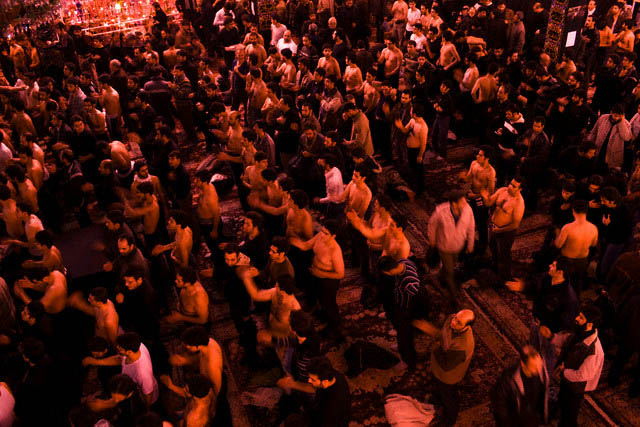
    The Shia have added many evil innovations to the faith, and this is why they are called Ahlel Bidah (the People of Bidah). One such Bidah (innovation) is the practise of Matam, in which the Shia beat themselves in Muharram on the day of Ashura. The Shia will slap their chests, beat their backs, and involve themselves in other practises in order to “commemorate” the dead.


  • Pictures of Matam

    Matam is a violent ritual performed by the Shia. This page contains graphic pictures of this Shia practise. Viewer beware: these are extremely graphic pictures and not for the faint of heart.


  • Matam Videos

    Here are some videos of Shia doing Matam. Viewer Beware! These videos are graphic and are not for the faint of heart. As can be seen, the Shia are giving Islam a bad name; the non-Muslims will see this and think that Muslims are nothing but uncivilized barbarians. This is definitely not Islam. Such ridicolous practises are reminiscent of pagan rituals of the most crude design!


  • Black Clothes

    The Shia Hadith declares that Amir Al-Mumineen Ali (رضّى الله عنه) and Imam As-Sadiq (رضّى الله عنه) declared it Haram (forbidden) to wear black clothes. And yet, we find the Shia scholars wearing black, as well as the Shia masses who do so out of a sense of religious obligation. This is truly an inconsistency in the Shia religion.


  • Why Sunnis Do Not Comemmorate Ashura

    The Shia sometimes ask why the Ahlus Sunnah does not participate in the Ashura comemmorations. This response by the Ahlel Bayt Admin should clarify the position of the Ahlus Sunnah, and it will expose the hidden agenda of the Shia who celebrate Ashura only as a means of spiting the Ahlus Sunnah.


See also: Why do some Catholics self-flagellate?


......................................................

The late Pope John Paul II would whip himself, according to a nun who helped to look after him. So how common is this practice in the Catholic faith?
"We would hear the sound of the blows," says Sister Tobiana Sobodka, who was in the next room to Pope John Paul II at his summer residence in Castel Gandolfo, near Rome.
.................................

A Mythical Mourning


Mourning and dancing for the martyrs
Mourning is the most moving aspect of Iranian Shi'ism. This is not an absolutely exclusive feature of this religion. Christianity also celebrates the Passion of Christ and glorifies its martyrs. In Sunni Islam one does not ignore the meaning that human suffering may have; the Sunnis even recognize in Hoseyn, killed at Karbala with his companions by the Umayyad army, an authentic martyr unjustly sacrificed. But the Shiites know more particularly the painful epic of the twelve successors of the Prophet deemed dead as martyrs, and their religious literature attests that, since the highest time, they were crying to receive the battle of their Imams, as invited by the Tradition: "Whoever weeps for or cries for Hoseyn will enter Paradise. "
In Iran, however, religious mourning, the commemoration ceremonies of the Karbala tragedy, is something else ... Like all the Iranian agglomerations, in August 1988, Arâk, a small town in central Iran where Khomeyni began eighteen years of his theological studies, celebrates the days of Tâsu'â and 'Âshurâ , the 9th and 10th of the lunar month of moharram, days when Hoseyn was tortured. Celebrations of great magnitude, with processions of flagellants, lamentations, music(drums, cymbals, fifes and beautiful male voices), behind banners, huge and magnificent insignia or emblems ...
mournersachura
Shiite womenAshura
Professional mourners at Achoura
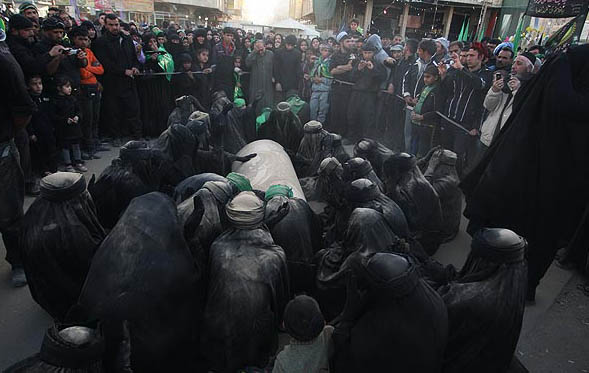
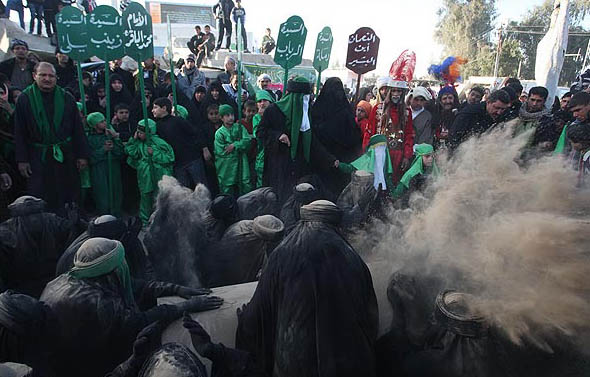
The whole city is boiling! Weeping groups come from each lane and march to the city center to return to their starting point where a meal is served by benefactors. The power of the show is hard to describe: men and women dressed in black, their faces serious, men beating their chests in rhythm, or striking themselves, sometimes strongly, with a small whip chain, apparently without feeling the slightest pain. Several men are walking barefoot, perhaps in accordance with a wish.
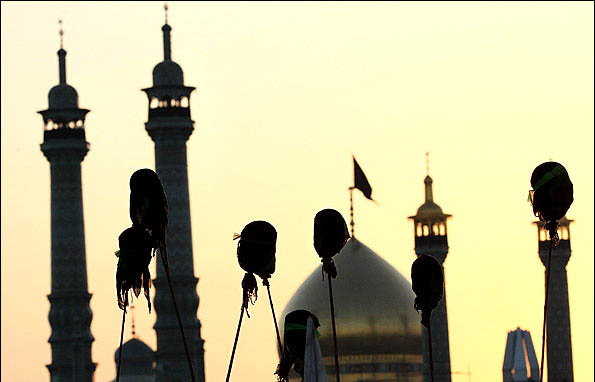
Khomeini Mosque in TehranHussein heads brandished in Qum
Some participants show heroism, especially those who, in turn, carry the heavy emblems mounted on a metal frame up to four meters wide, decorated with silver figurines (doves, camels), long, soft blades that bow with the wearer's step and decorated with kerosene lamps and precious fabrics. From time to time, before taking up their burial steps, the bearers of emblems stop in front of a group of women sitting in the shadow of a mosque and begin an astonishing and disturbing demonstration of their courage, turning on themselves with their load as if to defy gravity and to dance the most unreal and dangerous ballet that can be imagined: two men stand by their side to ward off the unexpected,
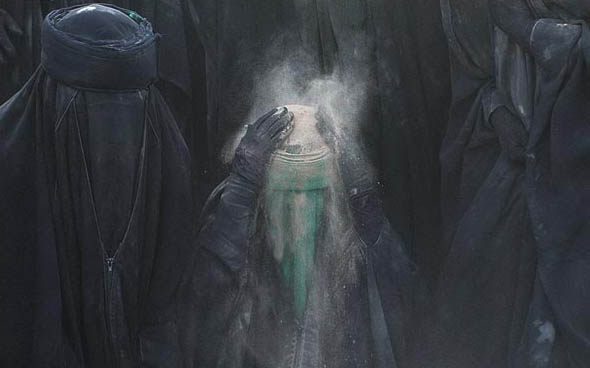
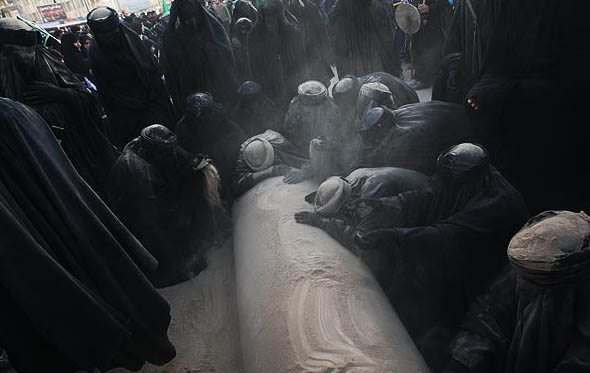
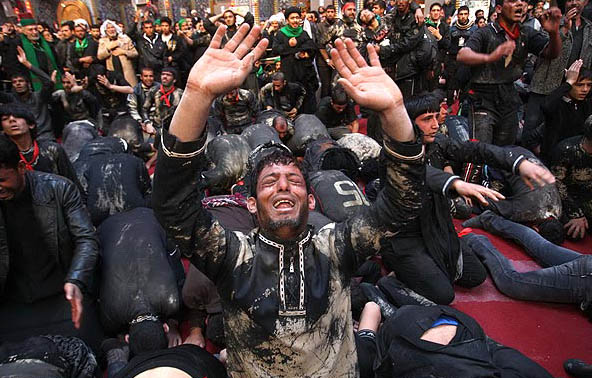
The procession includes only unshaven men and boys, some of whom have donned a sort of shroud to signify their acceptance of martyrdom. Many of the men, on the day of 'Ashurah, were stained with dried mud on the top of their skull and shoulders, a sign that they are preparing to be buried with Hoseyn. Elsewhere, there is evidence of many processions of men who deliberately wounded the skull with a knife to bleed profusely on the face.
 
Walking slowly under the sun by repeating, when prompted, a slogan or a chorus, they follow the instructions of the cantor who, in a microphone connected to a mobile amplification system, groans to chant his text, which he deciphers in a grimoire and improvises where inspiration permits. If there was one procession, one would think of a carefully organized and executed folk phenomenon. But there are hundreds in this small town.
It's a collective hysteria, a taste of thanatos that has swept the boundaries of all human respect. Where we go, mourning. The radio, the television, the buildings of the public services, everything is rhythmic by this beat, this color, everything is mobilized to manifest the death. The Iranians usually so sober in their collective manifestations, so few men of "representation" so little inclined to the futile spectacles, gather themselves in the hoseyniya to hear the preachers tell them for the hundredth time, for the thousandth time, the death of Hoseyn in Karbala, massacred with his 72 companions by the Umayyad army.
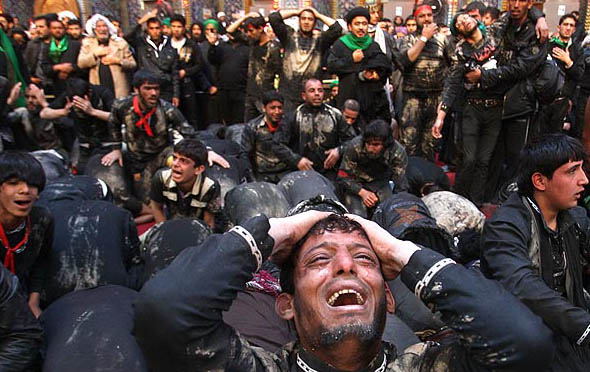
And they cry. They come to cry and they are told what it takes for the tears to flow. They really cry, together, in public, sincerely. They release themselves from the emotion contained elsewhere, where they are so prude and timid. As soon as the preacher's voice begins to shake, the sobs explode, one hits the chest.
mournersachura
Paranoiac Shi'ites crawl, shouting "Labayk Ya Hussein"
Elsewhere, in the city, but especially in the villages, there is organized such an exceptional and popular folk theater, ta'ziya . At the same time mystery and celebration, play and tragedy, where the public is all around an outdoor improvised stage (or in the hoseyniya ). The public and the actors are interchangeable: we know Yazid, 'Ali Akbar, Zeynab and Hazrat' Abbas ..., it is those of the village who can read and who are dressed for the occasion of the clothes of the drama. They have their text in hand and the director comes to ask them to read their part by giving them the microphone in their turn.
There's something marvelous about it, with the horses being fired in the middle, the firecrackers exploding during the battle, the hand of 'Abbas flying in the air before he succeeds in taking water in the Euphrates to water the companions of Hoseyn. There is blood, there are shocks of sabers spinning over the heads, there are drumbeats and sobs of death.

This exuberance of mourning and demonstration of morbid heroism is accompanied by a surreal festive climate. Refreshing syrups are distributed everywhere to compensate for the pain of Hoseyn in the arid plain of Karbala. Hearty meals are often given everywhere and often correspond to wishful wishes. We stay in the street late at night: broken with fatigue after having walked the streets the day before 'Ashurah, I hear again, from my bed, after midnight, singers and preachers, cymbals and bass drums; everywhere illuminations burst the night, making mourning forgetful.
The cohesion, the seriousness, the grandeur of these manifestations of 'Ashurâ make me almost afraid. Who would stop the army whose step is a dance, whose leader is that Hoseyn died one thousand three hundred years ago in Mesopotamia? In this collective happening, in this happy and profound grief of Shi'a mourning, there is no shapeless mass obedient to I do not know what agitator, but processions of district, communal groups, parish, in a street or in a bazaar corporation, religious associations proudly inscribe their names on the banner of their procession.
Certainly, we meet in the main street, but each group keeps its own sound, its own pace, its cohesion and finally returns to its own hoseyniya where the kabab, rice and syrup are waiting for it. In the main street, rivalries between neighborhoods, groups and associations can give rise to aggressive attitudes and manifestations of pride that are not compatible with the fusion and self-forgetfulness expected of a unitary demonstration.
The depth of feeling is in no way diminished by splitting. A Sunni Muslim who attends these ceremonies would probably be disgusted with the iramolate debauchery the Iranians are engaged in here. I do not seek to reassure those who are afraid of the collective fusion between religion and the nation, but even if its parish decomposition breaks any hint of political exploitation, the phenomenon is deeper, more complex than a simple mobilization ideological.

Throughout the city of Arak, among the dozens or hundreds of processions that converge towards the city center and then disperse to the neighborhoods from which they came, I see only one molla in dress, a seyyed. Is he aware of the exception he represents? It is well known that Shiite scholars have never favored ostentatious manifestations of mourning in the form of flogging, nor ta'ziya, which is its most elaborate form: they only advocate meetings where clerics -they are the main actors, as preachers, to tell the martyrdom of the holy Imams.
It is therefore a spontaneous ritual, against which neither the police nor the clergy would dare to attempt the slightest movement, but which organizes itself by a solid and unshakable tradition.
Religious feeling, from ritual to myth
The popularity in Iran of the celebrations of Hoseyn's death is an ancient phenomenon. Some authors have not hesitated to bring it closer to a pre-Islamic worship attested by literature - notably in the Book of the Kings of Ferdowsi, a tenth century Persian epic in which are told the founding events of the mythical history of the Iran - and some survivals of this cult are still attested in the provinces of Iran.
It is about the celebration of a hero, Siyavosh , incarnation of perfection, purity and bravery. Unjustly accused by his father's wife whose love advances he had rejected, Siyavosh triumphs out of an ordeal of fire, then, following a brilliant military expedition, he makes a covenant, for the sake of peace, with the enemies. vanquished from the king his father. Renowned by his own, Siyavosh will perish innocent victim of the hatred of men, beheaded by Afrâsyab, a relative of the king who gave him asylum.
"The population of Bukhara," says an old chronicle, "has on the massacre of Siyavosh many lamentations that we know in all the provinces and ministrels have composed songs that the singers call laments of the Magi. "
In the Book of the Kings of Firdousi, Siyavosh presents his torture and gives him an exemplary value:
It will not be long before this wicked and suspicious king makes me die cruelly, despite my innocence. Iran and Turan will be upset and revenge will be such that life will become a burden for men; the whole earth will be filled with misery and the sword of war will reign in the world.
[...] The king of Turan will then repent of what he did and what he said, but this repentance will not benefit him; for all the inhabited earth will be delivered to destruction, cries will be raised from Iran and from Turan, and my blood will cause trouble among men. This is how God wrote it to the firmament and all that sows bears fruit, as he commands ...
Siyavosh makes a dream that he describes to his wife:
My life is not far from its end and the pain of the bitter day approaches. Even if the roof of my palace had risen to Saturn, I should none the less drink the poison of death. Even if my life would have lasted twelve hundred years, I would have in the end for home only the black earth. One finds his tomb in the mouth of the lion, another is devoured by the vulture, a third by the golden eagle; but no man, whatever his knowledge, can convert darkness into light. [...]
This innocent head shall be cut off, and the blood of my heart shall be the crown of it; neither shall I be given a beer, or a burial-place, nor a shroud, and no one among this crowd shall weep over me; I will rest under the earth like a stranger, the head separated from the body by the sword.
Every Iranian, reading this thousand year old text, does not fail to make the connection with the hero of the cause of martyred faith in Karbala. We will also admire the genius of peoples to reinterpret and retranslate in a new symbolic language the intense emotions they feed on to face the trials of fate.
Although the literary texts celebrating the death of Hoseyn abound in the first centuries and emanate from Sunni circles (now casting a critical eye on the Umayyads) that Shi'a, it was not until the advent of the Safavids and the conversion of Iran to Shi'ism from the sixteenth century to public celebrations of the mourning of Hoseyn are organized in Iran.
From the book "The Shi'ite Islam" by Yann Richard
Mourning: Self-Flagellation (Matam)
  1. Mourning: Self-Flagellation (Matam-1A)
  2. The Ayatollahs Recommend Self-Flagellation (Matam-1)
  3. Self-Flagellation (Matam-2)
  4. Why Sunnis Do Not Comemmorate Ashura (Matam-3)
  5. خونی ماتم کے حوالے سے امام خامنہ ای کا فتوی -(Matam-4)
  6. ماتم کی ممانعت شیعہ تفسیر قمی و دیگر کتب Matam-5
  7. بعض کیتھولک عیسائی کیوں خونی ماتم اور سینہ کوبی کرتے ہیں ؟


Mutah

Shi’ism encourages Mutah, a form of prostitution, which is not only permissible in Shia fiqh but is actually considered Mustahabb (highly recommended). In Mutah, a man pays a woman a set amount of money ("Mehr") after which he is “temporarily married” to her and can engage in sexual relations with her until the agreed upon time limit runs out, which can be as little as one hour. The articles below will examine the immoral institution of Mutah.
“Mutah” translates literally to “pleasure” in Arabic. In the Shia context, Mutah refers to a “temporary marriage.” In the Shia faith, Mutah is actively encouraged and is considered Mustahabb (highly recommended). In reality, Mutah is an abomination, and is nothing less than prostitution.
The popular Shia website, Al-Shia.com, has an entire book on Mutah, titled “Narrations About the Rewards for Doing Mutah.” This book contains authentic Shia Hadith about Mutah. We have copied and pasted them here. These “Hadith” are troublesome, to say the least.
Every day, more and more girls in our community are falling victim to the idea of Mutah. These girls are helpless in asking anyone for help, especially their parents.This is the experience of one young Muslim girl who was tricked into doing Mutah. Her experience should serve as a lesson for us all.
Mutah is not only allowed in the Shia religion, but it is actually actively encouraged. Al-Kafi is the most reliable of the four Shia books of Hadith. Here are some Hadith from that book; it should be noted that the Ahlus Sunnah rejects these Hadith as Shia fabrications.
According to an official source in Tehran, there has been a 635 percent increase in the number of teenage girls in prostitution, or rather, Mutah. The magnitude of this statistic conveys how rapidly this form of abuse has grown. Officials of the Social Department of the Interior Ministry are worried about the increase in sexually transmitted diseases.
Ayatollah Khomeini is considered by the Shia to be the Wilayat Mutlaqah, or the Absolute Authority from Allah. He is the sole representative of the Hidden Imam. Here, we examine one of his statements about the institution of Mutah.
The following are Shia Hadith which expound the Fiqh of Mutah. It is abundantly clear that these so-called Hadith advocate prostitution and Zinnah, and go against the chastity that is a central tenet of true Islam.
The Iranian government recently passed legislation which created legal whore-houses, brothels which would be officially liscensed under law as “Chastity Houses.” Such a name is of course the epitome of Orwellian terminology, and the irony of the name should not be lost to anyone.
According to the Shia Fiqh, a man who has Mutah with a woman is not obligated to provide for her at all. In fact, even if she gets pregnant, the man still does not need to provide! In this article, we examine the religious edicts of Ayatollah Sistani and Ayatollah Lankarani.
The Ahlus Sunnah wal Jamaâ'ah compeletely rejects Mutah. This article will show how the Prophet completely forbade it, and how it is pure blasphemy to slander the Prophet by saying that he would encourage prostitution. This article refutes certain non-truths spread by Shia propagandists who attempt to “prove” Mutah via Sunni sources.
Using the institution of Mutah, it is very possible for women to gain a living by doing Mutah with one man and then immediately marrying another man, and so on and so forth. To the unbiased observor, this woman would be nothing more than a prostitute. The following question was asked on Al-Islam.org, the authoratative Shia website. The scholar passed the following Fatwa. No comments necessary, as it speaks for itself.
Here, we shall examine certain Shia Hadith which dictate that a woman will be forgiven her sins if she engages in Mutah twice. It seems that the Shia religion is immoral, and it advocates the exploitation of women via the institution of prostitution. Here, we see the deviant idea that women who give themselves in sexual pleasure to men (the definition of Mutah is literally “pleasure”) will be made pure and forgiven their sins. We wonder: how could fornication and prostitution make anyone pure? Logic tells us that it is nothing but an immoral act.
Shi’ism is a truly dangerous religion, and parents should be made aware of this Shia threat to the honor of Sunni girls. May Allah protect our women, as well as the women of the Shia who are also susceptible to being exploited by their Shia men. These Shia men can literally take away girls and have Mutah with them, without even the permission of the girl’s parents. And not only this, but these men believe themselves to be rewarded for this act of Mutah.
This craze to equate Mutah with Misyar is one of the desperate attempts of the Shia propagandists to conflate simple issues, just like they conflate abrogation with Tahreef. This is to hide their embarassment over their filthy religion which allows women to be rented by the hour.
If one reads Shia Hadith, it becomes very clear that the woman is treated as “rented” property. In this article, we examine quotes from the Shia website Al-Islam.org in which women are described as being “rented”.
Pleasure marriages were outlawed under Saddam Hussein but have begun to flourish again. The contracts, lasting anywhere from one hour to 10 years, generally stipulate that the man will pay the woman in exchange for sexual intimacy. Now some Iraqi clerics and women’s rights activists are complaining that the contracts have become…an outlet for male sexual desires.
In this article, we clarify the stance of the Ahl as-Sunnah with regards to the issue of marriage with the intention of divorce. Such marriages are not permissible.